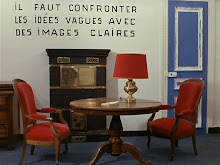
If The Fall is a study of a time and a place that simultaneously maps an inner landscape, La Chinoise is in some ways its reverse. A film that attentively traces the psychological, intellectual and ideological experiences of a small group of politicised French students, it is also a microcosm of a generation at a moment when revolution was a genuine, and earnestly desired for, possibility. In more recent years, it has even been hailed as prophetic: the quintessential May '68 film despite being completed and released in the summer of '67.
While dating the young actress Anne Wiazemsky (soon to be his wife), Jean-Luc Godard began spending time with Maoist radicals at the university where she was a student: Nanterre, one of the strongholds of student revolt in '68. Godard, who was discovering his own political identity at the time, was fascinated by the Maoists: they were passionate, militant and intellectually rigorous, and had divorced themselves from the PCF (the official French communist party). Soon Godard would be openly joining their ranks, but La Chinoise (filmed and edited in a matter of months in early '67) by no means makes this clear. As critic Keith Reader has written, the film "was generally perceived on its release as a satire on Maoism rather than a polemical embracing of it" and, unsurprisingly, Maoists hated it. More recently, the film has even been praised by critics such as Armond White for illustrating "how Left romanticism can betray personal and democratic ideals". Yet, if many of his characters' convictions were his own, why would he make a film (“a film in the process of making itself”, as he called it) that would reveal those same beliefs as so problematic?
In making sense of La Chinoise, it helps to recognise its position as one of the key transitional works in Godard's career—emerging at the end of his prolific string of French New Wave classics (from Breathless [1960] to Made in USA [1966]), and on the cusp of his stark rejection of commercial cinema under the guise of the Marxist-Leninist film collective, the Dziga Vertov Group. Weekend (1967), the film made immediately after La Chinoise, would signify his definitive break with what had come before (it ends with the words, "END OF CINEMA/END OF WORLD"), and it would in turn be followed by the minimalist Le Gai Savoir (1968), an explicit attempt to "return to zero" and start afresh. But in La Chinoise, the "old Godard" and the "new Godard" are both present, and the results reveal some of the consistent principles that have underlined the diverse phases of his career.
Godard's output from '60 to '67 has been firmly canonised in film history—but while the likes of Bande á Part (1964) and Alphaville (1965) have been re-released in DVD boxsets and parodied in commercials, almost everything since his '67/'68 shift has been ignored with impressive consistency. Most mainstream accounts characterise his subsequent developments as either a descent into dogmatism or solipsism—but in reality, Godard's turn in '68 was less of a foolhardy conversion than an inevitable tipping point. Since the start of his career, Godard had been experimenting with cinematic form. Searching for his own expressive language, Godard began by appropriating and reworking the styles and genres (mostly American) that had inspired him. However, as the '60s progressed, the social and political implications of these formal concerns became more and more pronounced, and Godard's innovations (still safely within the realm of mainstream narrative cinema, albeit on its margins) no longer seemed innovative enough. The emergence of a new generation of radical and culturally-engaged activists was undoubtedly one factor that accelerated Godard's development: according to his biographer, Richard Brody, it became evident to Godard "that the radical politics of the time had surpassed the radicalism of his cinema".
An awareness of and attempts to critique political and social problems had been working their way into Godard's films for several years, in tandem with a growing formal sophistication. The contrary looseness and irony of Breathless (rules of composition and montage violated, people playing at being movie stars and living out B-movie plots) gradually gave way to increasingly complex methods of self-reflexivity: jarring disruptions and dislocations of sound and image, actors breaking out of character, blatantly artificial actions and effects and, above all, a proliferation of quoted images (TV, movies, photographs, paintings) and texts (spoken by actors or narrators, inserted as titles, or scrawled on any available surface). For those who had misunderstood what he was attempting in the first place, these developments seemed like exasperating wrong turns—but Godard hadn't changed his approach so much as sharpened his tools.
If anyone had gone to Godard's films wishing to be told a story, it was abundantly clear by 1967 that they were looking in the wrong place. However, it's a mistake to characterise Godard's formal project in purely negative terms; his cinema, even at its most oblique, is as structured and principled as Hollywood narrative; they're just different structures and different principles, with different effects and implications. Several metaphors have been used to describe Godard's conception of cinema but perhaps the most useful was suggested by Serge Daney in an essay called "Godardian Pedagogy": cinema as school.
The metaphor can be applied in several ways and most of them are appropriate: Godard is alternately teacher and student, but so is the film itself; as are the actors and (potentially) the audience. This isn't school in its institutionalised sense (which in cinematic terms, would probably be called propaganda); the teacher/student dynamic in Godard's work is not a fixed hierarchy but an evershifting roleplay to facilitate learning. This is school as a place for asking questions and learning how to ask better ones; for challenging and being challenged; for studying, researching and experimenting; for making assertions, then revising them. School that is, as critic Nicole Brenez described Godard's cinema,
a permanent laboratory of understanding and exchange with phenomena, the place where we can see most clearly human thought at work, in its obscure stumblings, in the impatience of its efforts, its tensions and its ironies.
Nowhere does the metaphor fit as aptly than with La Chinoise. Like the three or so films that preceded it (Godard was averaging two a year by this stage), dense citations of images, texts and sounds abound in this film—but it's the first in which Godard's powers of juxtaposition and interrogation are matched by his own characters. One of the ways Godard facilitates this is by putting his characters in a scenario in which they can create their own makeshift montages. Limiting the film's action almost entirely to the plush apartment where the five politicised students spend their summer together, Godard offers his characters its blank walls and spacious rooms as a tabula rasa for use as their own screen, canvas, gallery, stage and, of course, classroom. The texts, images, sounds and performances with which they fill these spaces are still mostly orchestrated by Godard, but by dramatising his own formal techniques within the film's narrative, he manages to not just question the various social, political, cultural issues at hand, but question the very forms that his questions take.
That may sound like a tautological, postmodern stunt—but in the context of Godard's burgeoning politicisation and the revolutionary storms then on the horizon, it can be seen as an attempt to maintain perspective during heightened, impassioned times. This self-critical form can be considered in various ways, but one of the most important is its examination of Godard's extensive use of quotations. In many of Godard's '60s work, there is a sense that his characters are possessed by texts. In Masculin Feminin (1966), Godard famously describes his young Parisian characters as "the children of Marx and Coca-Cola", and the phrasing suggests how the youth for Godard are rarely in control of the signs they express themselves with; the texts speak them rather than the other way around. In La Chinoise, the process of radicalisation is revealed to be as susceptible to this as anything else. The characters may be quoting Mao rather than Bogart, but the problems are the same. As Anne Wiazemsky and Jean-Pierre Leaud say in the film's first few minutes: "We are the words of others".
The second target of self-critique is the way in which politics and ideology are inevitably mixed with baser human needs, desires and weaknesses. It's not just a critique of capitalism that sustains these revolutionaries, but also charisma (Leaud is an icon of French New Wave cinema), passion (is the Little Red Book everywhere because of its content or because of its colour?), spectacle (the agit-prop theatre, comic book imagery and pop music) and community (before La Chinoise, Godard's characters were usually loners). No wonder the Maoists were considered by some as France's political "New Wave". The film allows us to appreciate the energy of this, while never letting us forget that, as Brody writes, “These young people are in effect on summer vacation and not so much forming a cell as playing at one."
The third key object of self-critique is dogmatism. Keith Reader writes:
The dogmatic rhetoric that dominates the film has an incantory appeal, a self-enclosed and circular religious certainty that shuns the ambiguities of critical thought and introspection for the energising simplicity of exhortation and advocacy. To reach such naïve ecstasies, Godard had to film his own brainwashing.
But it's unfair to equate the film itself with the dogmatism it explores. Some scenes, such as Leaud erasing a list of great playwrights one by one until only Brecht is left, can be seen as expressions of Godard's own emerging purism (he certainly made many statements as sweeping as this in interviews), and in this sense, Brody is right to call this gesture “something of an intellectual suicide”. But in its position within the film, it is also an examination of that dogmatism in the process of working itself out: a truly dogmatic film would have simply stated "Brecht is theatre" rather than showing us the wilful negation that makes such a statement possible. As Gilles Deleuze put it, in Godard's hands, it is “a method which cinema must ponder at the same time as it uses it”.
This interrogation within the interrogation has another advantage, because while it pushes his self-critical approach further, it also gestures beyond it, raising the question of action. In putting Godard's methods into his characters' hands—into the world, so to speak—he leads us to ask what should actually be done. The paths of each character suggest several different possibilities, and none of them are ideal: one rejoins the Communist Party, another commits suicide, a third makes a bungled assassination attempt on a politician and Jean-Pierre Leaud embraces avant-garde theatre. If Godard seems to avoid drawing a conclusion here, it's partly because he really doesn't know. As he said of an earlier film, he devotes himself to problem posing rather than problem solving: "If one thinks after seeing the film, ‘he showed this but not the solution,’ one should be grateful to the film, not angry with it."
The specifics of La Chinoise's politics may be dated and, in key aspects, seriously misguided—but as a model of politicised film form it's still powerful. Both on its initial release and more recently, some have approached the film by seizing one single element as the film's overarching viewpoint. Jean de Baroncelli, for example, wrote at the time that the film was “an avatar—vintage 1967—of the eternal revolt of youth", while Armond White has since hailed the film for "refusing to be a pet of cultural progressives" and instead showing "their dogmatic rigidity and arrogance". This romanticism and cynicism are both in the film, but they do not define it, any more than the Maoist pop song (created specially for the film) could be taken as Godard's definitive take on Mao. The blogger Zach Campbell suggested that the most interesting thing about Godard is that "his didacticism is shared with the viewer—as is his ignorance". Daney observed that "there is always a great unknown in his pedagogy, and that is the fact that the nature of the relationship he maintains with his "good" discourses (those he defends) is undecidable." His work is one proof of the saying "trust the tale, not the teller"—or, put another way, the films have a greater capacity for honesty and clarity than their own author.
A case in point: In a key scene in the film, Wiazemsky (playing a Nanterre student) and Francis Jeanson (a real professor at Nanterre and former participant in the Algerian resistance) enact an unscripted debate on the necessity of violent action. Jeanson insists it is futile without popular grassroots support, but Wiazemsky (her responses dictated by Godard through an earpiece) begs to differ. The film gives each side an equal footing in the discussion, but Jeanson clearly emerges as the voice of reason here. And yet, during the making of the film, Godard believed that Jeanson was wrong—it would be years before Godard would come round to the perspective his own film seemed to put forth.
Even if the film's inquisitive openness allowed such perspectives to be included, there are still some things La Chinoise assumes as given. The students' attempts at re-definition are flawed, but re-definition is nonetheless essential; their attempts at resistance are naive, but resistance is still imperative. The film ends with two important lines by Wiazemsky that capture this mixture of humility and assurance: first, she admits her folly, saying “Yes, OK, it’s a fiction—but it brought me closer to reality.” The final line (accompanied by a title declaring "The End of a Beginning") could as well have been spoken by Godard: “I thought I had made a great leap forward, and now I realise that I have only made the first timid steps of a very long march.”
What's more, the act of quotation, despite its dangers, is ultimately seen by Godard as something to be harnessed rather than dismissed. Nicole Brenez says of Godard that "all the texts, sounds, shots and cuts in his work are citational and, if they ever appear original, it is simply because we have not yet come across the reference." The problem is not in the act of quoting itself. As Godard says, "When I shoot in the street then that, too, is a quote for me. After all, I didn't invent the Champs-Elysées." The question is in our ability to appropriate them, to use them rather than be used by them. Many years later, in the final minutes of his magnum opus, Histoire(s) du Cinema (1988-1998), Godard would quote a passage by Denis de Rougemont from his book Penser Avec Les Mains. Rougemont asserts that "man's true condition is to think with his hands". But in taking creative action,
... The danger is not in our tools but in the weakness of our hands ... A thought which abandons itself to the rhythm of its own mechanisms proletarianises itself. Such a thought no longer lives of its own creation. Man is formed by others.
This process by which our thought is "proletarianised" (that is, made to be submissive, alienated, no longer our own) can be at the hands of a cinematic form, an ideology, or any other unquestioned premise underlying our expressions and actions. And it's from here that we can see that Godard's endless forms of reflection and interrogation are not an avoidance of radical action but a method by which those actions can be truly radical—that is, our own.