Saturday, March 28, 2009

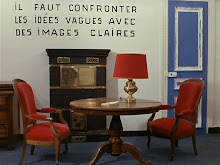
ICI ET AILLEURS (1976, Anne-Marie Miéville and Jean-Luc Godard)

The notion of making "films politically" that has been explored in this series is akin in many ways to the concept of prefigurative politics: political action that embodies the social structures and forms of relationship it wishes to promote, rather than merely espousing them. This can be applied to cinema from various angles, but the most evident starting point is the way in which the filmmaking process itself is organised. For radical filmmakers in the '60s and '70s, this was an area of much reinvention and experimentation, and film collectives were the locus for a lot of it. Between the US and France, there were dozens of radical film collectives producing films between between 1967 and 1975, with at least ten alone in Paris. The collective form provided a "prefigurative" filmmaking process in several ways: by pooling resources and skills, filmmakers were able to maintain greater independence from commercial funding bodies as well as avoiding exploitative wage-labour structures within their own crews---a situation which, in theory at least, left both the filmmakers and their crews free of the coercion that financial contracts can precipitate. But above all, film collectives figured an attack on the dictatorship of the director, rejecting singular authorial control in favour of a collaborative and egalitarian creative process.

Jean-Luc Godard's approach to collectivism was novel: he pretended. While many sources still refer to Godard's abandonment of commercial cinema in 1968 as a genuine retreat into collectivist practice, the reality was something different. Though almost all of Godard's films from '68 to '72 (none of which feature any on-screen credits) are attributed to the Dziga Vertov Group, this group for the most part consisted of two people (Godard and journalist and activist Jean-Pierre Gorin), and sometimes not even that. As director Jacques Rivette put it, the Dziga Vertov Group was "collective in the same way that the regime in Peking was a democracy". The decision to adopt the Dziga Vertov Group mantle was more an attempt to repudiate Godard's own cult status as an auteur (and the iconic films that went with it) than to reinvent the filmmaking process itself. 

Although this period of collectivism may have been something of a charade, Godard nonetheless emerged from it with a renewed concern for the political implications of the filmmaking process: in particular, he found himself haunted by the nature of the relationship between the filmer and the filmed. The ideology of collectivism tended to obscure the specifics of filmmaking relations under a general impression (and official policy) of equality: we are told the film is made by the collective, its subjects appear to be participating equally, and given no more information we are left to assume (or doubt) that the film is the equal product of an unknown number of people. Emerging from the Dziga Vertov Group period in the mid-'70s, Godard rejected this in favour of an approach that emphasised both his singularity as filmmaker, and that of the people he was filming. While Newsreel talked about "assimilation of the individual into the collective", such a proposition was doomed to failure with an iconoclast like Jean-Luc---although the more dogmatic of his Dziga Vertov films suggest he may not have realised this at first. The problem was not to abolish the differences between individuals (which was impossible and, anyway, dangerous) but to respect them in a way that also facilitated understanding and exchange. The problem was not "us"---as the Dziga Vertov Group had seemed to suggest---but "me and you".

Ici et Ailleurs (Here and Elsewhere) is one of Godard's most focused examinations of this problem and the first film in which he seems to become fully conscious of it---but it's an issue which can be traced back to his early work. The minute Godard began to integrate documentary elements into his scripted, fictional narratives, he was sowing the seeds of this question of relationship. While never the most liberal or hands-off of directors to work with, as the '60s developed, Godard was increasingly foregrounding spontaneous elements. Occasionally, genuine documentary footage is included but, more often, the documentary aspect of fictional scenes are emphasised. Sequences are edited in ways that emphasise their reality as a moment of performance in the making of a film, rather than their artificiality as a plot point in a made-up story. Much as Godard's films are expressions of his own personality, they are also confrontations with something completely "other": the people he films who, even when they are reading his lines, he does not fully control or understand. From this point of view, all Godard's films could be called documentaries in a way: the popular, genre-twisting films from '60 to '66 are all documentaries about movie stars pretending to be B-movie characters; in the transitional La Chinoise (1967), the movie stars pretend to be revolutionaries. With the beginning of the Dziga Vertov Group, Godard began filming real revolutionaries instead, and the implications of this dynamic between the director and his subjects started coming into focus.

The Dziga Vertov period saw Godard and Gorin shooting projects around Europe, the US and, on one sole occasion, the Middle East. In 1970, they were invited by Al Fatah, the dominant faction of the Palestinian Liberation Organisation, to make a film about the militant group in their camps in Jordan and Lebanon. The film was to be called Until Victory, and Godard and Gorin intended to present the militants as exemplary models of revolutionary practice and struggle, expressing solidarity with their cause. Filming was completed in the summer of 1970---about three months before "Black September", during which thousands of Palestinians were massacred by the forces of Jordan's King Hussein. Almost all of the "actors" of Until Victory were among the dead.

The tragic turn of events forced to the surface questions that had been submerged in all of Godard's work. Critic Serge Daney described it like this:
The cinema [is] the place of a crime and a kind of magic. The crime: that images and sounds are taken from...living beings. The magic: that they are exhibited in another place (the movie theatre) to give pleasure to those who see them. The beneficiary of the transfer: the filmmaker. This is true pornography, this change of scene; it is, appropriately, the ob-scene.
The question that Godard had to face as the filmmaker in the middle of this "crime" was what his responsibility was to those he filmed---both at the moment of filming and, afterwards, in how he used their image.

It was five years later, as part of a new partnership with filmmaker Anne-Marie Miéville, when Godard returned to the Palestinian footage to address these questions. The film that results is in some ways one of Godard's most austere works: all vestiges of narrative have been purged and there are no longer charismatic actors speaking for him. Instead we are given an intricate essay of images, sounds and text, combining the Palestinian footage with staged scenes of a working-class French family, photographs of politicians and war with advertisements, and the words of the Palestinians with those of Godard and Miéville. If the film seems excessively complex, it is first and foremost because its concerns are so basic. According to his biographer Richard Brody, Godard
blamed himself and Gorin for having attempted to make a film that was not about what the Palestinians were in fact saying and doing, but about what he and Gorin had wanted to say and to do (as was of course apparent from their storyboard and script).
To correct the mistake, it was necessary therefore to really see what was in the images that they had filmed, not what they had wanted to find or even what Al Fatah had wanted to show them. In order to do that, it was necessary to understand what it really means to film something in the first place. The French Marxist philosopher Louis Althusser, a major influence on Godard, wrote something in the '60s that sums up the project Godard had set himself:
I venture to suggest that our age threatens one day to appear in the history of human culture as marked by the most dramatic and difficult trial of all, the discovery and training in the meaning of the 'simplest' acts of existence: seeing, listening, speaking, reading---the acts which relate men to their works, and to those works thrown in their faces, the 'absences of work'.
In Ici et Ailleurs, this return to the "simplest" acts is not academic, but an act of repentance. Much of the Dziga Vertov Group's work could be said to have embodied gestures of solidarity, and even unity, with international radical struggles (films were also made in Italy, Britain and Czechoslovakia). The failure of the Palestinian project highlighted the illusions and elisions that made such an expression possible. Above all, it failed to take into account difference---between you and me, France and Palestine, filmer and filmed, and everything else. They weren't seeing clearly, and hence, they hadn't thought or acted clearly either.

The film has three main sections in which it attacks these problems. In the first, Godard's and Gorin's original vision for the Palestinian project is outlined. It was to consist of four key images: that of "the people's will", "the armed struggle", "the political work", "the prolonged struggle", with each image leading to the next and continuing until the final image: until victory. These are the images, as Daney put it, "that the PLO wants to see broadcast in France ... They are the images of any propaganda movie." As it turned out, victory was not the end point of this sequence of images, but death. Attaching this final image to the sequence, Godard is forced to re-evaluate the original images, as well as the process by which they were linked. 

The second part of the film leaves Palestine to one side and explore the latter problem in more depth: the political implications of cinema's most fundamental powers, the juxtaposition of one image against another and of sounds against images. If the first part is defined by a unity (the revolutionary cause) and linearity (one thing leading to another leading to victory), the second part is all about differentiation, or put more positively, relationship. As Miéville reminds us in the narration, "in 1970 this film was called Until Victory---in 1975, it is called Here and Elsewhere." In this new formulation, the "and" becomes pivotal, and the second part of the film largely revolves around the search for the exact nature of this conjunction, the "et" that can both connect and separate. By this point, the unified, seamless progression of images has been discredited: text appears at one point claiming "death is represented in this film by a flow of images". 

However, the implication is not that this seamless flow of images is really unified, but that by suppressing the question of relationship, it ends up instigating regressive ones. As critic Bill Nichols has written, "film cannot be reified into a thing. It is primarily a system of relationships between things". Godard suggests that the original project of Until Victory created a system of relationships that was ultimately disempowering and dishonest, and his claims that such "chains" of images threaten to replace us and alienate us from our own powers finds further evidence in the mass media all around us, and is illustrated in the film by the repeated intercutting of the French family passively watching TV. In fact, it closely echoes Guy Debord's theory of the Spectacle, that "vast inaccessible reality that can never be questioned" and which, Debord explains, is primarily "a social relation between people that is mediated by images". The question becomes not unity versus differentiation, but simply: what forms of relationship (what kinds of "and") are possible in cinema?

The third and final part of the film returns to the Palestinian footage, prepared to formally and critically investigate it: to understand what is really in the images, what relates them to and what separates them from each other. This section involves analyses both of what is in the Palestinian images, and what is left out of them. A scene depicting a militant leader speaking to a large group is criticised for its hierarchical structure: "The one that represents the people is speaking alone, far from the people. As usual, theatre." Another scene, of a young, illiterate woman learning a revolutionary statement by rote, is criticised for submitting an individual to someone else's words. Miéville asserts that "texts talk but never about silence"---in other words, they never talk about what they are excluding, and the great loss in this image is suggested to be what this woman would have said had she been allowed to speak with her own words. 

This notion of silence is a recurring one, and sound is seen as one of the key methods of obscuring sight: earlier Godard laments that he had failed to see his images properly because the sound (exemplified by a blaring revolutionary anthem) was playing too loud. These were "sounds that hide silence", that obscured the image and drowned out what it had to say. But the biggest silence is the presence of the filmmaker himself. A close-up of a pregnant Palestinian woman talking about her willingness to give her son to the cause is revealed by Miéville to be a woman that Godard and Gorin have cast to play the part (and she is filmed, as James Quandt has observed, "with the same tender but wary regard" Godard used to treat Anna Karina in his earlier films). We are allowed to hear Godard behind the camera, directing her to "straighten your head a little" and Miéville observes, "It's always the one who is directed that is seen, never the one directing".

Another key aspect of this sequence is that, while the voice of Godard led the earlier parts, Godard and Miéville are now equal narrators, with Miéville taking on a somewhat adversarial role, challenging, as Brody puts it, "both his earlier approach to the subject and his attempt to make good on it now". She even goes so far as to say to Godard what all of us have wanted to at one time or another: "Listen, be a little simpler!" This is not the first time Godard has collaborated with a lover, but unlike his previous wives and muses (the actresses Anna Karina and Anne Wiazemsky), this is the first time the "and" that connects them has been of a fully reciprocal, balanced nature.

The question the film confronts is whether such a relationship (in essence, a "prefigurative" one) is possible between the filmmaker and the filmed---and also, on the other side of the cinematic process, whether it is possible between the filmmaker and his viewers. The critical interrogation of imagery posited in the film's final section suggests some potential redemption (not least in offering a critical model for viewers to apply to other films)---but in the case of the Palestinian situation, this is of course too little too late. The real failure came at the moment of filming, the failure to understand what they were really engaging in : as Miéville puts it to Godard, "It was up to you to say it and what is tragic is that you didn't." There is even a further suggestion that the fascination with faraway struggles is partly motivated by an avoidance of our own present circumstances (and it's important to realise that the "elsewhere" in the film's title is not just distant Palestine, but also our alienation from our own lives). Miéville, as usual, puts it most pointedly: "If we wanted to make the revolution for them, it's perhaps because at that time we didn't really want to make it where we are."

All of the filmmakers in this series have contemplated the potential limits of film as a political form. In response to a film critic's praise over his innovative use of cinematic techniques in The Fall, Peter Whitehead responded dejectedly: 
But I had been trying to change the world not the language of cinema, confront the fascist tyranny of objectification of everything and everyone. I felt defeated, betrayed by film, my own film most of all. Vicarious avoidance of participation; a preoccupation which was its own predicament.
Whitehead would give up film soon after this film (he was spent most of the last forty years working as a falconer for a Saudi Arabian prince). Robert Kramer, in a trajectory somewhat similar to Godard, gave up direct political engagement by the mid-'70s but continued making films until his death in 1999. If the act of filmmaking inevitably involves some kind of distanciation and disconnection from one's environment, Godard would no doubt argue that it's a necessary one. Critic Nicole Brenez has cited the philospher Maurice Merleau-Ponty to sum up Godard's approach: 
At the conclusion of a reflection that first cuts him off, but in order to make him better feel the links of truth that attach him to the world and to history, the philosopher finds, not the abyss or the self or of absolute knowledge, but the renewed image of the world, and himself planted, among the others, in that world.
In this equation, cinema is a form of disconnection that can, in the end, facilitate deeper connection; it has the potential to, in Gorin's words, "drive you back to your own reality". If Godard's aim with Ici et Ailleurs was, as Daney put it, to"restore images to the bodies on which they have been taken", it was also arguably an attempt to restore himself to the world with renewed capacities, including the ability to live out responses to questions like: "How to use one's time to occupy space?" Or another one: "How to construct one's own  image?"

Of course, with Godard, it always comes back to questions. Observing a French mother shrug off a difficult question from her daughter, Godard comments:
Nobody knows how to answer, or answers are crooked. We don't do much better anyway. ... One ends up thinking that it's not the answers that don't fit, but the questions. 
It's a start.

Wednesday, March 18, 2009

ICE (1969, Robert Kramer)

Like The Fall and La ChinoiseIce is an exploration and critique of radical activism that strives to be both involved and sceptical. In Kramer's case, it's a dual commitment that leads to an endless series of contradictions: Ice is both a genre piece (thriller, sci-fi, espionage) and a documentary (loose handheld camerawork, long takes and improvising non-actors); its characters have a clear narrative objective and yet we're often not quite sure what's going on; the film's huge, dispersed cast figure an intricate web of links and implications reminiscent of The Wire, but we're often as lost in this web as its characters; their enemies are treated as faceless and brutal, yet we are lead in many scenes to question the legitimacy of their whole project of resistance. Kramer wants to immerse and implicate us in the events depicted at the same time as pushing us to constantly question them and perhaps Kramer—who features in the film as one of its most troubled characters—wants to create this state of being for himself.

Where Ice differs from the previous two films is that it emerged directly from the movement it was depicting, and was produced and performed by its active participants. Unlike Whitehead and Godard, Robert Kramer was not an outsider beginning to immerse or indoctrinate himself in activist culture. A community organiser and member of Students for a Democratic Society (one of the flagship groups of the US New Left movement) since the early '60s, Kramer had come to filmmaking as a subset of his activism rather than the other way around. So while Whitehead's and Godard's films occasionally give the sense of a stranger trying to learn the customs and languages of an alien world, Kramer's starting point is a world he knows only too well. This foundation explains the difference of emphasis between Kramer's vision and the other two filmmakers. The Fall and La Chinoise spend a lot of time inspecting the social, cultural and intellectual structures that motivate and underpin '60s radicalism, and deliberating alongside its protagonists over what action should be taken. In Ice, we are presented with characters who have already made their mind up and whose discussions are only ever concerned with the ongoing practice of resistance. If there is an analytical side to Kramer's style here, it's concerned less with understanding as a precondition for action than with understanding at the same time as acting.

All of this goes some way towards explaining the obvious fact that Ice is, technically, not actually a depiction of the New Left movement at all. Set in a near future in which police oppression has escalated and the US is at war with Mexico, the film focuses on a decentralised network of armed radicals co-ordinated by the National Committee of Independent Revolutionary Organisations, whose stated mission is the destruction of the state. While the Black Panther Party (whose trademark slogan "All Power to the People" is appropriated in the film) were prominent exponents of revolutionary violence at the time the film was made, their tactics were a subject of much contention and division within the New Left movement. In fact, only months after Ice was completed in 1969, these divisions led to the split of SDS and the formation of various splinter groups including the infamous Weather Underground. The prospect of violent revolt was certainly "in the air", but its advocates were only one faction of a fragmented opposition, and there was certainly no network of groups strategically committed to it...at least not yet. Within that context, Ice can be seen as a speculative vision of the Movement's potential, a "what if?" scenario that takes some of the era's radical tendencies to their logical conclusion and considers their effects. It was a vision that many in the Movement did not approve of, and the film was in the end rejected and disowned by the very film collective that had produced it.

The Newsreel film collective was founded in the wake of the 1967 march on the Pentagon by a group of several dozen filmmakers and activists in New York City, including Kramer. Its impetus had been to co-ordinate the production and distribution of documentary films covering events and issues relevant to radicals and often ignored or misrepresented in the mainstream media. Its initial success was considerable: within its first two years, the collective had produced and distributed over 60 films and set up satellite groups in several cities across America. But, as critic Bill Nichols observed, The Newsreel had something of a barometric relationship to the wider movement, and was inevitably destabilised by the internal divisions that had begun to weaken the movement as a whole. As early as April, 1968, the group issued a collective statement which was frank about their own doubts:
For the most part we have relied on coverage and presentation as our basic format. In extending ourselves we have gone into those areas dominated by the “media”; our imaginations have failed to probe what would be considered new ground; this applies to our film technique as well as our politics (whatever the fuck that is) …. It is no great accomplishment to be able to cover a peace march or a demonstration … We might only be imitating the coverage of the networks which is exactly what we don't want.
Similar doubts were emerging in the New Left movement as a whole, the cohesiveness of which was increasingly precarious, and really held together only by what activist Paul Buhle called "negative unity"—in other words, everybody knew what they were against, just not always quite what they were for. Even when ends were clear, the question of means was problematic. If Newsreel feared that they were, as critic Michael Renov put it, recycling the techniques of broadcast television "in unreconstructed form, to serve radical aims", this was also an issue for the Movement as a whole in terms of the techniques of resistance it employed. In a feature on Newsreel in the winter '68 issue of Film Quarterly, Robert Kramer rejected this tendency outright, declaring: "Your sense of order and form is already a political choice."

This line of thinking can be seen as formative in the making of Ice, which began filming not long after Kramer made the statement. By imagining the Movement's future from within the Movement itself, Kramer was also reflecting on its current state, including the situation of The Newsreel. Indeed, the entire formal project of Ice can be considered an attempt to adequately describe the world in which its makers lived. As Kramer would say many years later, it was one of many efforts to create "the new language necessary to discuss situations which are themselves new, burgeoning or, as yet, non-existent". The film was a departure from The Newsreel's previous output in several respects, most glaringly in its use of a fictional premise—but also because it undermined their policy of collectivity: no individuals were credited for their part in a Newsreel film, and roles were often shared, with different parts of a film shot and edited by different people. Although Ice sticks to Newsreel's policy of no credits, the film was in fact written and directed by Kramer, and produced with a $15,000 dollar grant from the American Film Institute (who thought they were getting a science fiction short for their money), which allowed Kramer to circumvent the processes of collective approval and subsidy that most Newsreel films underwent.

But the film's biggest point of departure was its formal innovation. While most Newsreel films had rejected the conventions of traditional cinema on a superficial level (mainstream notions of "production value" were consistently ignored, for example), this was rarely developed into any kind of comprehensive formal approach. According to Kramer, he found himself "in the position of being the one who wanted to change the form in order to align with the change in meaning"—and if Ice is a film about the forms of action which resistance takes, it is also a meditation on the capacity of film to embody such a resistance: a quest for a more radical, and more active, cinematic form.

For Kramer, this obsession with "form" was not merely aesthetic; it was a concern with the structures that defined our perceptions, our understandings and our actions. The characters of Ice are case studies in this, with each one offering a different perspective on the social, emotional, psychological and physical effects of political activism and resistance. The most urgent formal question is the use of violence, and it's one that Kramer (who slept with a gun under his pillow for most of the '60s) wrestled with endlessly during this period. Although the revolutionaries' own violence is mostly presented second-hand or off-screen, its individual effects (which the protagonists experience both as perpetrators and as victims) are a recurring theme. In one key scene, a member of the group worries that the movement is becoming "inhuman somehow", and gestures to his gun as the core problem. At other moments, characters are driven to coercive methods out of frustration when other methods fail: one militant even tells his own parents, as he struggles to convince them to shelter his injured friend, "You're gonna do what I say, or I'm gonna kill you!" The question here is of course the elemental question of whether the ends justify the means, and it's easy to argue that violence, as a form of resistance, is inherently regressive; as Kramer would later say, it's difficult "to imagine that violence and coercion can do anything but replicate their massive violence and coercion."

But Kramer extends the question of means and ends into more subtle areas, suggesting that it's not simply weapons that risk dehumanising us. The film is also a reflection on the effects of collectivism, and as a form of organisation, it's presented as problematic both in terms of its threat to individuality and its capacity for masking subtler inequities. There is often a sense in the film that its characters are caught in the flow of a movement, the totality of which they cannot really comprehend. In a key line late in the film, one of the most prominent (but largely characterless) revolutionaries states, "You just gotta think about your ideas not being your ideas but being part of a movement of things". This sense of depersonalisation leaves individuals submitting to a larger, ungraspable whole—and leads Howard, the caretaker of the movement's database and one of the film's few sceptical voices, to accuse them of being like puppets.

At the same time, the film's depictions of committee meetings and decision-making within the group raises the question of how collective and non-hierarchical this revolutionary organisation really is. The same question could be directed at the The Newsreel itself; according to Paul McIsaac, one of Ice's actors, Newsreel was really
controlled by a small group of 'heavies' and Robert was definitely one. In the old days someone like Robert and one or two other (male) leaders would have taken charge and run the group directly. But this was the New Left and we were a "collective". So they ran the group, indirectly.
Renov called these men the "core elite": those "college-educated white males" who were "verbal, assertive, confident". We can see their counterparts in Ice in the parts of the charismatic men (including McIsaac and Kramer) who often appear to dominate proceedings. This is part of a larger pattern in the film in which the group's self-professed ideals are revealed as often easier said than done. Although this is presented in a myriad of ways, it's at its bluntest in the scene where Kramer, in the middle of translating a recording of a French radical speech, stops to shout at his girlfriend, "Rachel! Where's dinner?"

Behind the flippancy of such an obvious moment of hypocrisy is an implication that emerges again and again throughout the film: our human weaknesses and desires, our bodily needs and frailties, are often at odds with our political ideals and ideologies. Indeed, political action can sometimes positively endanger these things. Sometimes this is generated by the spectre of police oppression (Kramer hysterically claims at one point after being tortured by the police, "They want to take our sex away from us!"), but sometimes it is simply by virtue of the physical and emotional strain of a life absorbed in activism. The film's long takes and intimate camerawork emphasise the lived experience and physical toll of this lifestyle, and the film's iconic signature image pictured above (in which ideology, in the form of a popular May '68 slogan, is literally inscribed in a person's flesh) serves as a vivid symbol of it. 

Significantly, one particular form of resistance critiqued in the film is filmmaking itself. Interspersed throughout the film are the revolutionary committee's own cinematic works; short, austere propaganda movies produced by the movement's "film division" (who are portrayed by Newsreel's own members). The films are characterised by strong, declaratory texts and narration—lines like "armed struggle of the whole people is the only way to destroy the state" are typical—coupled with often simplistic imagery. The contrast with the style of the film's other sequences is stark. As critic Ray Carney has written:
The films the revolutionaries make are proud, confident, self-assured, and tendentious. The film Kramer makes is the opposite: It is humble and exploratory. It asks questions and keeps its mind open to unforeseen possibilities. The films within the film treat ideological concepts like "imperialism," "freedom," "false consciousness," and "revolutionary activity," as if they could be disconnected from the rest of life. Kramer reconnects ideology with the emotional and intellectual untidiness of lived experience.
This notion of "reconnection" is an important one since Kramer's project is clearly not an attempt to negate one for the other, but to find a means of integrating them: of bringing ideals into reality and the body into politics. Kramer's challenge is to create a form that engages with its characters' radicalism but also goes beyond it, sees what it cannot see and makes the connections it is unable to make. To quote Carney again: 
His work is ideologically informed without being limited by the shallowness of ideological forms of understanding. It is political without yielding to the tendentiousness of political analysis.
It is also a revolutionary fantasy—expressing, as McIsaac put it, "the dreams, nightmares and aspirations of the Movement"—that does not yield or submit to its own projections. It's the New Left's dark subconscious (the genre plot) and it's conscience (the critical form) at the same time—a dichotomy often mistaken for one or the other but whose whole brilliance rests on it being both; a film that forces identification and critique at the same time, as part of a constant movement.

One of the film's main formal strategies for achieving this is by completely blending elements of documentary and fiction. By incorporating genre elements within a documentary-like context, Kramer addresses fiction and performance as real-world phenomena: the fiction of ideology, the performance of resistance. Howard tells one revolutionary that she is mistaking illusions for reality, things that are "moulded by your own egos and your own tastes"; another despairs at one point that all they're doing is "playing cops and robbers". Also, the partiality of the film's style (we are not privy to all the important information; sometimes the camera misses things) puts us in an exploratory position, constantly revising our understanding of what we see—a position which works against the ideological certainty and commitment of the revolutionaries' actions.

There is never any indication that Kramer thinks the revolutionaries are misguided in their opposition or critique of the world they live in—but what he relentlessly scrutinises is the imperfections of the forms that this opposition takes. When it came to both filmmaking and activism, he was weary of what he called "the subtle forms of domination and control" that can seep into one's practice. He would have no doubt identified with Guy Debord's assertion that "a revolutionary organisation must ... see to it that the dominant society's conditions of separation and hierarchy are not reproduced within itself". In effect, Kramer's choice to focus on radical resistance (and generally ignore the issues and structures against which it is opposed) can be seen as an attempt to turn his characters' "negative unity" into a conscious positivity; to move from a coalition based on shared opposition, to one dedicated to consciously reinventing its own relationship with the world. If Ice (like most of Kramer's films) doesn't really seem to have an ending, it's because there is no possible conclusion to this project: as Kramer would write years later,
It was clear that changing things, in oneself or in the world, is not an event, a specific moment or act, but a process that never actually ends.

Saturday, February 28, 2009

LA CHINOISE (1967, Jean-Luc Godard)

If The Fall is a study of a time and a place that simultaneously maps an inner landscape, La Chinoise is in some ways its reverse. A film that attentively traces the psychological, intellectual and ideological experiences of a small group of politicised French students, it is also a microcosm of a generation at a moment when revolution was a genuine, and earnestly desired for, possibility. In more recent years, it has even been hailed as prophetic: the quintessential May '68 film despite being completed and released in the summer of '67.

While dating the young actress Anne Wiazemsky (soon to be his wife), Jean-Luc Godard began spending time with Maoist radicals at the university where she was a student: Nanterre, one of the strongholds of student revolt in '68. Godard, who was discovering his own political identity at the time, was fascinated by the Maoists: they were passionate, militant and intellectually rigorous, and had divorced themselves from the PCF (the official French communist party). Soon Godard would be openly joining their ranks, but La Chinoise (filmed and edited in a matter of months in early '67) by no means makes this clear. As critic Keith Reader has written, the film "was generally perceived on its release as a satire on Maoism rather than a polemical embracing of it" and, unsurprisingly, Maoists hated it. More recently, the film has even been praised by critics such as Armond White for illustrating "how Left romanticism can betray personal and democratic ideals". Yet, if many of his characters' convictions were his own, why would he make a film (“a film in the process of making itself”, as he called it) that would reveal those same beliefs as so problematic?

In making sense of La Chinoise, it helps to recognise its position as one of the key transitional works in Godard's career—emerging at the end of his prolific string of French New Wave classics (from Breathless [1960] to Made in USA [1966]), and on the cusp of his stark rejection of commercial cinema under the guise of the Marxist-Leninist film collective, the Dziga Vertov Group. Weekend (1967), the film made immediately after La Chinoise, would signify his definitive break with what had come before (it ends with the words, "END OF CINEMA/END OF WORLD"), and it would in turn be followed by the minimalist Le Gai Savoir (1968), an explicit attempt to "return to zero" and start afresh. But in La Chinoise, the "old Godard" and the "new Godard" are both present, and the results reveal some of the consistent principles that have underlined the diverse phases of his career.

Godard's output from '60 to '67 has been firmly canonised in film history—but while the likes of Bande á Part (1964) and Alphaville (1965) have been re-released in DVD boxsets and parodied in commercials, almost everything since his '67/'68 shift has been ignored with impressive consistency. Most mainstream accounts characterise his subsequent developments as either a descent into dogmatism or solipsism—but in reality, Godard's turn in '68 was less of a foolhardy conversion than an inevitable tipping point. Since the start of his career, Godard had been experimenting with cinematic form. Searching for his own expressive language, Godard began by appropriating and reworking the styles and genres (mostly American) that had inspired him. However, as the '60s progressed, the social and political implications of these formal concerns became more and more pronounced, and Godard's innovations (still safely within the realm of mainstream narrative cinema, albeit on its margins) no longer seemed innovative enough. The emergence of a new generation of radical and culturally-engaged activists was undoubtedly one factor that accelerated Godard's development: according to his biographer, Richard Brody, it became evident to Godard "that the radical politics of the time had surpassed the radicalism of his cinema".

An awareness of and attempts to critique political and social problems had been working their way into Godard's films for several years, in tandem with a growing formal sophistication. The contrary looseness and irony of Breathless (rules of composition and montage violated, people playing at being movie stars and living out B-movie plots) gradually gave way to increasingly complex methods of self-reflexivity: jarring disruptions and dislocations of sound and image, actors breaking out of character, blatantly artificial actions and effects and, above all, a proliferation of quoted images (TV, movies, photographs, paintings) and texts (spoken by actors or narrators, inserted as titles, or scrawled on any available surface). For those who had misunderstood what he was attempting in the first place, these developments seemed like exasperating wrong turns—but Godard hadn't changed his approach so much as sharpened his tools.

If anyone had gone to Godard's films wishing to be told a story, it was abundantly clear by 1967 that they were looking in the wrong place. However, it's a mistake to characterise Godard's formal project in purely negative terms; his cinema, even at its most oblique, is as structured and principled as Hollywood narrative; they're just different structures and different principles, with different effects and implications. Several metaphors have been used to describe Godard's conception of cinema but perhaps the most useful was suggested by Serge Daney in an essay called "Godardian Pedagogy": cinema as school.

The metaphor can be applied in several ways and most of them are appropriate: Godard is alternately teacher and student, but so is the film itself; as are the actors and (potentially) the audience. This isn't school in its institutionalised sense (which in cinematic terms, would probably be called propaganda); the teacher/student dynamic in Godard's work is not a fixed hierarchy but an evershifting roleplay to facilitate learning. This is school as a place for asking questions and learning how to ask better ones; for challenging and being challenged; for studying, researching and experimenting; for making assertions, then revising them. School that is, as critic Nicole Brenez described Godard's cinema, 
a permanent laboratory of understanding and exchange with phenomena, the place where we can see most clearly human thought at work, in its obscure stumblings, in the impatience of its efforts, its tensions and its ironies.
Nowhere does the metaphor fit as aptly than with La Chinoise. Like the three or so films that preceded it (Godard was averaging two a year by this stage), dense citations of images, texts and sounds abound in this film—but it's the first in which Godard's powers of juxtaposition and interrogation are matched by his own characters. One of the ways Godard facilitates this is by putting his characters in a scenario in which they can create their own makeshift montages. Limiting the film's action almost entirely to the plush apartment where the five politicised students spend their summer together, Godard offers his characters its blank walls and spacious rooms as a tabula rasa for use as their own screen, canvas, gallery, stage and, of course, classroom. The texts, images, sounds and performances with which they fill these spaces are still mostly orchestrated by Godard, but by dramatising his own formal techniques within the film's narrative, he manages to not just question the various social, political, cultural issues at hand, but question the very forms that his questions take.

That may sound like a tautological, postmodern stunt—but in the context of Godard's burgeoning politicisation and the revolutionary storms then on the horizon, it can be seen as an attempt to maintain perspective during heightened, impassioned times. This self-critical form can be considered in various ways, but one of the most important is its examination of Godard's extensive use of quotations. In many of Godard's '60s work, there is a sense that his characters are possessed by texts. In Masculin Feminin (1966), Godard famously describes his young Parisian characters as "the children of Marx and Coca-Cola", and the phrasing suggests how the youth for Godard are rarely in control of the signs they express themselves with; the texts speak them rather than the other way around. In La Chinoise, the process of radicalisation is revealed to be as susceptible to this as anything else. The characters may be quoting Mao rather than Bogart, but the problems are the same. As Anne Wiazemsky and Jean-Pierre Leaud say in the film's first few minutes: "We are the words of others".

The second target of self-critique is the way in which politics and ideology are inevitably mixed with baser human needs, desires and weaknesses. It's not just a critique of capitalism that sustains these revolutionaries, but also charisma (Leaud is an icon of French New Wave cinema), passion (is the Little Red Book everywhere because of its content or because of its colour?), spectacle (the agit-prop theatre, comic book imagery and pop music) and community (before La Chinoise, Godard's characters were usually loners). No wonder the Maoists were considered by some as France's political "New Wave". The film allows us to appreciate the energy of this, while never letting us forget that, as Brody writes, “These young people are in effect on summer vacation and not so much forming a cell as playing at one."

The third key object of self-critique is dogmatism. Keith Reader writes:
The dogmatic rhetoric that dominates the film has an incantory appeal, a self-enclosed and circular religious certainty that shuns the ambiguities of critical thought and introspection for the energising simplicity of exhortation and advocacy. To reach such naïve ecstasies, Godard had to film his own brainwashing.
But it's unfair to equate the film itself with the dogmatism it explores. Some scenes, such as Leaud erasing a list of great playwrights one by one until only Brecht is left, can be seen as expressions of Godard's own emerging purism (he certainly made many statements as sweeping as this in interviews), and in this sense, Brody is right to call this gesture “something of an intellectual suicide”. But in its position within the film, it is also an examination of that dogmatism in the process of working itself out: a truly dogmatic film would have simply stated "Brecht is theatre" rather than showing us the wilful negation that makes such a statement possible. As Gilles Deleuze put it, in Godard's hands, it is “a method which cinema must ponder at the same time as it uses it”.

This interrogation within the interrogation has another advantage, because while it pushes his self-critical approach further, it also gestures beyond it, raising the question of action. In putting Godard's methods into his characters' hands—into the world, so to speak—he leads us to ask what should actually be done. The paths of each character suggest several different possibilities, and none of them are ideal: one rejoins the Communist Party, another commits suicide, a third makes a bungled assassination attempt on a politician and Jean-Pierre Leaud embraces avant-garde theatre. If Godard seems to avoid drawing a conclusion here, it's partly because he really doesn't know. As he said of an earlier film, he devotes himself to problem posing rather than problem solving: "If one thinks after seeing the film, ‘he showed this but not the solution,’ one should be grateful to the film, not angry with it."

The specifics of La Chinoise's politics may be dated and, in key aspects, seriously misguided—but as a model of politicised film form it's still powerful. Both on its initial release and more recently, some have approached the film by seizing one single element as the film's overarching viewpoint. Jean de Baroncelli, for example, wrote at the time that the film was “an avatar—vintage 1967—of the eternal revolt of youth", while Armond White has since hailed the film for "refusing to be a pet of cultural progressives" and instead showing "their dogmatic rigidity and arrogance". This  romanticism and cynicism are both in the film, but they do not define it, any more than the Maoist pop song (created specially for the film) could be taken as Godard's definitive take on Mao. The blogger Zach Campbell suggested that the most interesting thing about Godard is that "his didacticism is shared with the viewer—as is his ignorance". Daney observed that "there is always a great unknown in his pedagogy, and that is the fact that the nature of the relationship he maintains with his "good" discourses (those he defends) is undecidable." His work is one proof of the saying "trust the tale, not the teller"—or, put another way, the films have a greater capacity for honesty and clarity than their own author.

A case in point: In a key scene in the film, Wiazemsky (playing a Nanterre student) and Francis Jeanson (a real professor at Nanterre and former participant in the Algerian resistance) enact an unscripted debate on the necessity of violent action. Jeanson insists it is futile without popular grassroots support, but Wiazemsky (her responses dictated by Godard through an earpiece) begs to differ. The film gives each side an equal footing in the discussion, but Jeanson clearly emerges as the voice of reason here. And yet, during the making of the film, Godard believed that Jeanson was wrong—it would be years before Godard would come round to the perspective his own film seemed to put forth.

Even if the film's inquisitive openness allowed such perspectives to be included, there are still some things La Chinoise assumes as given. The students' attempts at re-definition are flawed, but re-definition is nonetheless essential; their attempts at resistance are naive, but resistance is still imperative. The film ends with two important lines by Wiazemsky that capture this mixture of humility and assurance: first, she admits her folly, saying “Yes, OK, it’s a fiction—but it brought me closer to reality.” The final line (accompanied by a title declaring "The End of a Beginning") could as well have been spoken by Godard: “I thought I had made a great leap forward, and now I realise that I have only made the first timid steps of a very long march.” 

What's more, the act of quotation, despite its dangers, is ultimately seen by Godard as something to be harnessed rather than dismissed. Nicole Brenez says of Godard that "all the texts, sounds, shots and cuts in his work are citational and, if they ever appear original, it is simply because we have not yet come across the reference." The problem is not in the act of quoting itself. As Godard says, "When I shoot in the street then that, too, is a quote for me. After all, I didn't invent the Champs-Elysées." The question is in our ability to appropriate them, to use them rather than be used by them. Many years later, in the final minutes of his magnum opus, Histoire(s) du Cinema (1988-1998), Godard would quote a passage by Denis de Rougemont from his book Penser Avec Les Mains. Rougemont asserts that "man's true condition is to think with his hands". But in taking creative action,
... The danger is not in our tools but in the weakness of our hands ... A thought which abandons itself to the rhythm of its own mechanisms proletarianises itself. Such a thought no longer lives of its own creation. Man is formed by others.
This process by which our thought is "proletarianised" (that is, made to be submissive, alienated, no longer our own) can be at the hands of a cinematic form, an ideology, or any other unquestioned premise underlying our expressions and actions. And it's from here that we can see that Godard's endless forms of reflection and interrogation are not an avoidance of radical action but a method by which those actions can be truly radical—that is, our own. 

Saturday, February 14, 2009

THE FALL (1969, Peter Whitehead)

In “I Destroy, Therefore I Am”, a revealing essay written shortly after completing The Fall, Peter Whitehead writes, “For me my only weapon is film.” Notions of the assaultive power of moving images are almost as old as cinema itself, but such rhetoric came into its own in the 1960s. The increasingly transparent forces of state oppression, particularly as seen in the Vietnam War (the first televised war), lent an air of urgency to artistic activity. The Newsreel, a New York-based radical film collective, talked about making films that “explode like grenades in peoples’ faces”, and this desire for confrontation was widespread, informing strategies across the arts. Whitehead was not a political activist, however, and if he used cinema as a weapon, it was an interrogative rather than a coercive one, and something he wielded against himself as much as those around him. He describes his film in its opening as “a series of historical moments seeking a synthesis”, and in its diverse documentation of late ‘60s New York it is certainly that. But it is also very much a personal attempt to make sense of the world in order to act within it: a study of an individual seeking a praxis. As Whitehead would later say, “I put myself together by putting the film together.”

Starting his career as a TV cameraman, Whitehead directed a series of documentaries on British subjects throughout the ‘60s, including Charlie Is My Darling (1966), following the Rolling Stones on tour in Ireland, and culminating with Tonite Let’s All Make Love in London (1967), the quintessential document of “Swingin’ London”. Feeling he had exhausted his interest in the London scene—he later said, “There seemed nothing more to film in London except my boredom, despair and apathy”—Whitehead took the opportunity of an invitation to the New York Film Festival to make a film about the cultural and political upheavals then in motion in the US. He would spend the next few months (from October 1967 to June 1968) living in and filming New York City.

From the sixty or so hours of footage Whitehead brought back to England with him, several films could have been made. There was undoubtedly ample material for a compelling cinema verité-style documentary, as his contemporaries Frederick Wiseman and the Maysles Brothers were (and still are) doing: a document of things “as they happened”, without narration or interviews. A director with a specific political agenda may have assembled the footage as a defence and rallying call for the New Left Movement, venerating activists and reinforcing their claims, while demonising the State. But Whitehead’s film is unique in that it is neither impartial nor didactic. The Fall does not argue the case of the New Left movement or any of its factions, but neither does it assume any pretense of objectivity towards its subjects. Instead, it foregrounds Whitehead’s own relationship to events (going so far as to add scenes of himself revisiting footage in the editing room), and creates a dialectic between distanced appraisal and impassioned advocacy, facilitated by Whitehead’s ambivalence towards radical politics. A natural filmmaker-voyeur (he admitted to impulsively “zooming and panning and editing with my eyes and ears”), Whitehead was astute and observant enough to recognise the myriad ways in which modern society was alienating and dispossessing its citizens, and the need for individual and collective resistance. But he was too observant to commit wholeheartedly to most of the forms of resistance he saw taking place. Yearning for a way to engage with and counter the injustice around him, Whitehead was nonetheless committed to doing so with his eyes wide open—whether that meant including details that undermined the radical cause, or even those that undermined his own authority as the filmmaker.

This (perhaps irreconcilable) struggle between taking action and seeing clearly is so fundamental that it informs The Fall at every level—politically, aesthetically and metaphysically—and explains why the film takes the shape it does; it wouldn’t make sense to explore such a question within a form that had already, implicitly, settled on answer. Stylistically raw, exultant and startling, and packed with unexpected cuts and abrasive music, The Fall juts and jars around in ways that can at first seem haphazard and confused. While confusion is a necessary component of the problem Whitehead is exploring, if the film itself seems unformed, it’s only because, on a narrative level, we are not privy to a story or verbal argument on which to hang on to. Most political cinema tends to foreground “the message”, considering formal concerns as secondary or even peripheral, so it may take some adjustment to recognise that it’s at the formal level that Whitehead’s real political exploration is taking place.

The most overt element of this approach is the film’s three-part structure: In part one, “The Image”, Whitehead absorbs himself in the spectacle of the city, passively taking in the sights and the sounds. Part two, “The Word”, introduces Whitehead in the editing room, trying to structure and take control of this imagery; here, he says, “I start cutting, analysing and thinking.” In the final section, “Word and Image”, the possibility of a synthesis of vision and action is explored through the filmmaker’s participation in the 1968 student occupation of Columbia University.

Within each of these parts, Whitehead explores the film’s central question in several ways, considering different forms of resistance (and co-option), critiquing his own position as an observer, and in the tour de force climactic frenzy of the middle section, seeking a way to act through film itself. As it progresses, there are elements that may seem highly objectionable, but start to make more sense when considered in relation to the whole. In the film’s first section, Whitehead articulates his passive submission to spectacle through a channel-hopping montage aesthetic that actively works against the kind of synthesis the film professes to be seeking. Addressing the commodification and co-option of radical politics (already remarkably widespread by 1967), he dives into it head first, arranging a fashion shoot of an Italian model wearing a “peace dress” and telling her to act sexy. As isolated segments, these sequences could be argued to be part of the problem Whitehead is seeking to overcome, but within the multi-layered and self-critical mosaic that The Fall amounts to, they are strategies to be experienced and questioned rather than approved or submitted to.

Two more complex examples later on in the film bring this issue into focus. In what at first seems like one of the film’s most irrelevant and indulgent sequences, Whitehead films the Italian model (now his girlfriend) dancing in his apartment, his camera roaming her body in an unabashedly sexualised and predatory fashion. But the legitimacy of this scene’s approach is undermined from all directions. Aurally, the scene’s imagery is undercut with a quite brilliant narration from Whitehead that seems oblivious to the allure of its visual counterpart, abstractly discussing urban alienation and notions of objectification and objectivity, particularly as exploited by the media. Structurally, it is directly followed by a photographer discussing an erotic image of Marilyn Monroe and how the photograph must be transformed into an object in order to be sold. But above all, by emphasising Whitehead’s presence in the scene, and his relationship with his subject, the film brings the idea of objectification out of the mass media and into an interpersonal context, and in the process underlines the flawed and partial gaze of the cameraman whose images we have been immersed in.

A little later, we witness perhaps the most disturbing scene in the film: a Destructivist performance art event in which the artist Ralph Ortiz beats a chicken to death against a piano. The act is horrific, and the degree of Whitehead’s complicity in filming the event (though no more so than that of the paying audience which also witnessed it) should not be glossed over. But by being positioned so centrally and openly in the film (and paired with another steely voiceover, this time asserting that “murder is the ultimate act of objectification”), the scene serves both as a corrective to historical notions of ‘60s radical art, and a further interrogation of Whitehead’s position within the film. On the one hand, the alienation and frustration that fueled the social and cultural storms of the ‘60s is revealed at its basest and least romantic; on the other, Whitehead’s equivocation between detachment and engagement is now no longer tenable: witnessing is participating.

Whitehead has speculated that his films may have been “acts of aggression against film, against limits put on me by the nature of film itself”—and The Fall can be understood as an attempt to put those limits to the test. As participatory as the act of filming inevitably is, the indexical, second-hand nature of moving images can often militate against any sense of participation and engagement for the viewer—the social effect of which Guy Debord had brilliantly outlined in his book The Society of the Spectacle, the same year that Whitehead began The Fall. In Whitehead’s words:
In the culture we live in images are used to alienate us, not to invite us to participate. … The whole principle of the modern society in which we are saturated by images is that the images are aggressive, violating. They are violating us and deliberately making us feel alienated from everything, including ourselves, our own feelings and our own natural selves. The Fall is the ultimate expression of this kind of engulfment in images.
However, in “expressing” this engulfment, Whitehead seeks not to submit to it but to transform it. How to make an image that is not alienating—an image that demands participation, that empowers rather than pacifies? Whitehead implies: not by telling us to be empowered, or by illustrating empowerment, but by embodying it. As critic Ray Carney has put it, “you must reinvent the language to make it capable of carrying the meanings [you want] it to bear”. Recalling Serge Daney’s phrase that someone with a true passion for cinema expects everything from cinema, including “that cinema should free him from cinema”, Whitehead ultimately rejects the (too easily co-opted) theatre of protest and the (self-defeating) frustrated idealism of destruction, hesitantly embracing instead the collective and prefigurative direct action of the Columbia occupation—a position that inevitably pushes beyond cinema altogether.

Of course, as The Fall powerfully depicts, the Columbia occupation—and the ‘60s New Left movement as a whole—largely failed. As Whitehead would later say, “What I was actually filming was the collapse - the 'fall' - of an increasingly ineffective and impotent protest movement.” Nonetheless, as an attempt to redefine the relationship between cinema and the spectator that is both forceful and generous, this film has few peers. At one point in the film, Robert Lowell introduces a poem by clarifying, “This is not a propaganda poem, it’s a lived poem—there’s a difference”. Whitehead would later assert:
I want people to examine, re-examine their response to the world, their ability to see it as true or false. It's the basis of any morality, this belief in one's own experience. … I have used this film to re-examine my own existence and hope it will thus become valid for someone else, not because I tell them about it. I try to let it happen to them, by letting the film that happened to me, happen to them.
In bringing us into a “lived film”, Whitehead challenges us to match his own interrogative powers and to consider different models of vision and action—while acknowledging that the fundamental question of “what next?” is not something he can answer for us.

Wednesday, February 11, 2009

INTRODUCTION


"Films Politically" is a new series of Experimental Film Club screenings taking place at the autonomous social centre Seomra Spraoi, every second Tuesday at 8pm, beginning on February 17th. The series will explore the convergence of film and radical politics in the late 1960s from the perspective summed up in Jean-Luc Godard's famous line: "The problem is not to make political films, but to make films politically."

For over a century, film has been recognised as a powerful political tool---but in the heightened climate of the US and Europe in the late 1960s, that power was understood in new and innovative ways. One of the key characteristics of the radical cinema that emerged in this time, particular in the epicentres of New York and Paris, was a keen awareness of the political implications of form, style and the filmmaking process that has often been neglected in contemporary radical and activist filmmaking.

For these filmmakers, it was not possible to simply make a Hollywood film, using the established modes of production and distribution and the established stylistic and narrative conventions, and insert within that a set of radical anti-war or anti-capitalist messages. It was not possible because those established conventions were not neutral, but had serious political implications themselves, implications that overrided any message one may try to propagate within them.

This series of screenings attempts to explore some of the new, politicised forms of cinema that were created during this time, and discuss what lessons they may hold for activists and artists in today’s world.

---------------------------------------------------------------

The Experimental Film Club is dedicated to creating forums for the exploration of diverse and often neglected film works. It is perceived that there are a large number of people interested and engaged in aspects of experimental filmmaking in Dublin but no meeting point to build on this shared interest and knowledge. The club has been organising monthly screenings in the Ha'penny Bridge Inn since March 2008.

Seomra Spraoi is an autonomous social centre in Dublin city centre. It is run by a non-hierarchical collective on a not-for-profit basis. It hosts workshops, gigs, political meetings, film screenings, a vegan cafe and lots more. The centre seeks to be a hub of positive resistance, in a city and society where public spaces have been eaten away by consumerism, property speculation and the culture of the car.