
Like The Fall and La Chinoise, Ice is an exploration and critique of radical activism that strives to be both involved and sceptical. In Kramer's case, it's a dual commitment that leads to an endless series of contradictions: Ice is both a genre piece (thriller, sci-fi, espionage) and a documentary (loose handheld camerawork, long takes and improvising non-actors); its characters have a clear narrative objective and yet we're often not quite sure what's going on; the film's huge, dispersed cast figure an intricate web of links and implications reminiscent of The Wire, but we're often as lost in this web as its characters; their enemies are treated as faceless and brutal, yet we are lead in many scenes to question the legitimacy of their whole project of resistance. Kramer wants to immerse and implicate us in the events depicted at the same time as pushing us to constantly question them and perhaps Kramer—who features in the film as one of its most troubled characters—wants to create this state of being for himself.
Where Ice differs from the previous two films is that it emerged directly from the movement it was depicting, and was produced and performed by its active participants. Unlike Whitehead and Godard, Robert Kramer was not an outsider beginning to immerse or indoctrinate himself in activist culture. A community organiser and member of Students for a Democratic Society (one of the flagship groups of the US New Left movement) since the early '60s, Kramer had come to filmmaking as a subset of his activism rather than the other way around. So while Whitehead's and Godard's films occasionally give the sense of a stranger trying to learn the customs and languages of an alien world, Kramer's starting point is a world he knows only too well. This foundation explains the difference of emphasis between Kramer's vision and the other two filmmakers. The Fall and La Chinoise spend a lot of time inspecting the social, cultural and intellectual structures that motivate and underpin '60s radicalism, and deliberating alongside its protagonists over what action should be taken. In Ice, we are presented with characters who have already made their mind up and whose discussions are only ever concerned with the ongoing practice of resistance. If there is an analytical side to Kramer's style here, it's concerned less with understanding as a precondition for action than with understanding at the same time as acting.
All of this goes some way towards explaining the obvious fact that Ice is, technically, not actually a depiction of the New Left movement at all. Set in a near future in which police oppression has escalated and the US is at war with Mexico, the film focuses on a decentralised network of armed radicals co-ordinated by the National Committee of Independent Revolutionary Organisations, whose stated mission is the destruction of the state. While the Black Panther Party (whose trademark slogan "All Power to the People" is appropriated in the film) were prominent exponents of revolutionary violence at the time the film was made, their tactics were a subject of much contention and division within the New Left movement. In fact, only months after Ice was completed in 1969, these divisions led to the split of SDS and the formation of various splinter groups including the infamous Weather Underground. The prospect of violent revolt was certainly "in the air", but its advocates were only one faction of a fragmented opposition, and there was certainly no network of groups strategically committed to it...at least not yet. Within that context, Ice can be seen as a speculative vision of the Movement's potential, a "what if?" scenario that takes some of the era's radical tendencies to their logical conclusion and considers their effects. It was a vision that many in the Movement did not approve of, and the film was in the end rejected and disowned by the very film collective that had produced it.
The Newsreel film collective was founded in the wake of the 1967 march on the Pentagon by a group of several dozen filmmakers and activists in New York City, including Kramer. Its impetus had been to co-ordinate the production and distribution of documentary films covering events and issues relevant to radicals and often ignored or misrepresented in the mainstream media. Its initial success was considerable: within its first two years, the collective had produced and distributed over 60 films and set up satellite groups in several cities across America. But, as critic Bill Nichols observed, The Newsreel had something of a barometric relationship to the wider movement, and was inevitably destabilised by the internal divisions that had begun to weaken the movement as a whole. As early as April, 1968, the group issued a collective statement which was frank about their own doubts:
For the most part we have relied on coverage and presentation as our basic format. In extending ourselves we have gone into those areas dominated by the “media”; our imaginations have failed to probe what would be considered new ground; this applies to our film technique as well as our politics (whatever the fuck that is) …. It is no great accomplishment to be able to cover a peace march or a demonstration … We might only be imitating the coverage of the networks which is exactly what we don't want.
Similar doubts were emerging in the New Left movement as a whole, the cohesiveness of which was increasingly precarious, and really held together only by what activist Paul Buhle called "negative unity"—in other words, everybody knew what they were against, just not always quite what they were for. Even when ends were clear, the question of means was problematic. If Newsreel feared that they were, as critic Michael Renov put it, recycling the techniques of broadcast television "in unreconstructed form, to serve radical aims", this was also an issue for the Movement as a whole in terms of the techniques of resistance it employed. In a feature on Newsreel in the winter '68 issue of Film Quarterly, Robert Kramer rejected this tendency outright, declaring: "Your sense of order and form is already a political choice."
This line of thinking can be seen as formative in the making of Ice, which began filming not long after Kramer made the statement. By imagining the Movement's future from within the Movement itself, Kramer was also reflecting on its current state, including the situation of The Newsreel. Indeed, the entire formal project of Ice can be considered an attempt to adequately describe the world in which its makers lived. As Kramer would say many years later, it was one of many efforts to create "the new language necessary to discuss situations which are themselves new, burgeoning or, as yet, non-existent". The film was a departure from The Newsreel's previous output in several respects, most glaringly in its use of a fictional premise—but also because it undermined their policy of collectivity: no individuals were credited for their part in a Newsreel film, and roles were often shared, with different parts of a film shot and edited by different people. Although Ice sticks to Newsreel's policy of no credits, the film was in fact written and directed by Kramer, and produced with a $15,000 dollar grant from the American Film Institute (who thought they were getting a science fiction short for their money), which allowed Kramer to circumvent the processes of collective approval and subsidy that most Newsreel films underwent.
But the film's biggest point of departure was its formal innovation. While most Newsreel films had rejected the conventions of traditional cinema on a superficial level (mainstream notions of "production value" were consistently ignored, for example), this was rarely developed into any kind of comprehensive formal approach. According to Kramer, he found himself "in the position of being the one who wanted to change the form in order to align with the change in meaning"—and if Ice is a film about the forms of action which resistance takes, it is also a meditation on the capacity of film to embody such a resistance: a quest for a more radical, and more active, cinematic form.
For Kramer, this obsession with "form" was not merely aesthetic; it was a concern with the structures that defined our perceptions, our understandings and our actions. The characters of Ice are case studies in this, with each one offering a different perspective on the social, emotional, psychological and physical effects of political activism and resistance. The most urgent formal question is the use of violence, and it's one that Kramer (who slept with a gun under his pillow for most of the '60s) wrestled with endlessly during this period. Although the revolutionaries' own violence is mostly presented second-hand or off-screen, its individual effects (which the protagonists experience both as perpetrators and as victims) are a recurring theme. In one key scene, a member of the group worries that the movement is becoming "inhuman somehow", and gestures to his gun as the core problem. At other moments, characters are driven to coercive methods out of frustration when other methods fail: one militant even tells his own parents, as he struggles to convince them to shelter his injured friend, "You're gonna do what I say, or I'm gonna kill you!" The question here is of course the elemental question of whether the ends justify the means, and it's easy to argue that violence, as a form of resistance, is inherently regressive; as Kramer would later say, it's difficult "to imagine that violence and coercion can do anything but replicate their massive violence and coercion."
But Kramer extends the question of means and ends into more subtle areas, suggesting that it's not simply weapons that risk dehumanising us. The film is also a reflection on the effects of collectivism, and as a form of organisation, it's presented as problematic both in terms of its threat to individuality and its capacity for masking subtler inequities. There is often a sense in the film that its characters are caught in the flow of a movement, the totality of which they cannot really comprehend. In a key line late in the film, one of the most prominent (but largely characterless) revolutionaries states, "You just gotta think about your ideas not being your ideas but being part of a movement of things". This sense of depersonalisation leaves individuals submitting to a larger, ungraspable whole—and leads Howard, the caretaker of the movement's database and one of the film's few sceptical voices, to accuse them of being like puppets.
At the same time, the film's depictions of committee meetings and decision-making within the group raises the question of how collective and non-hierarchical this revolutionary organisation really is. The same question could be directed at the The Newsreel itself; according to Paul McIsaac, one of Ice's actors, Newsreel was really
controlled by a small group of 'heavies' and Robert was definitely one. In the old days someone like Robert and one or two other (male) leaders would have taken charge and run the group directly. But this was the New Left and we were a "collective". So they ran the group, indirectly.
Renov called these men the "core elite": those "college-educated white males" who were "verbal, assertive, confident". We can see their counterparts in Ice in the parts of the charismatic men (including McIsaac and Kramer) who often appear to dominate proceedings. This is part of a larger pattern in the film in which the group's self-professed ideals are revealed as often easier said than done. Although this is presented in a myriad of ways, it's at its bluntest in the scene where Kramer, in the middle of translating a recording of a French radical speech, stops to shout at his girlfriend, "Rachel! Where's dinner?"
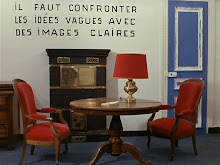
Behind the flippancy of such an obvious moment of hypocrisy is an implication that emerges again and again throughout the film: our human weaknesses and desires, our bodily needs and frailties, are often at odds with our political ideals and ideologies. Indeed, political action can sometimes positively endanger these things. Sometimes this is generated by the spectre of police oppression (Kramer hysterically claims at one point after being tortured by the police, "They want to take our sex away from us!"), but sometimes it is simply by virtue of the physical and emotional strain of a life absorbed in activism. The film's long takes and intimate camerawork emphasise the lived experience and physical toll of this lifestyle, and the film's iconic signature image pictured above (in which ideology, in the form of a popular May '68 slogan, is literally inscribed in a person's flesh) serves as a vivid symbol of it.
Significantly, one particular form of resistance critiqued in the film is filmmaking itself. Interspersed throughout the film are the revolutionary committee's own cinematic works; short, austere propaganda movies produced by the movement's "film division" (who are portrayed by Newsreel's own members). The films are characterised by strong, declaratory texts and narration—lines like "armed struggle of the whole people is the only way to destroy the state" are typical—coupled with often simplistic imagery. The contrast with the style of the film's other sequences is stark. As critic Ray Carney has written:
The films the revolutionaries make are proud, confident, self-assured, and tendentious. The film Kramer makes is the opposite: It is humble and exploratory. It asks questions and keeps its mind open to unforeseen possibilities. The films within the film treat ideological concepts like "imperialism," "freedom," "false consciousness," and "revolutionary activity," as if they could be disconnected from the rest of life. Kramer reconnects ideology with the emotional and intellectual untidiness of lived experience.
This notion of "reconnection" is an important one since Kramer's project is clearly not an attempt to negate one for the other, but to find a means of integrating them: of bringing ideals into reality and the body into politics. Kramer's challenge is to create a form that engages with its characters' radicalism but also goes beyond it, sees what it cannot see and makes the connections it is unable to make. To quote Carney again:
His work is ideologically informed without being limited by the shallowness of ideological forms of understanding. It is political without yielding to the tendentiousness of political analysis.
It is also a revolutionary fantasy—expressing, as McIsaac put it, "the dreams, nightmares and aspirations of the Movement"—that does not yield or submit to its own projections. It's the New Left's dark subconscious (the genre plot) and it's conscience (the critical form) at the same time—a dichotomy often mistaken for one or the other but whose whole brilliance rests on it being both; a film that forces identification and critique at the same time, as part of a constant movement.
One of the film's main formal strategies for achieving this is by completely blending elements of documentary and fiction. By incorporating genre elements within a documentary-like context, Kramer addresses fiction and performance as real-world phenomena: the fiction of ideology, the performance of resistance. Howard tells one revolutionary that she is mistaking illusions for reality, things that are "moulded by your own egos and your own tastes"; another despairs at one point that all they're doing is "playing cops and robbers". Also, the partiality of the film's style (we are not privy to all the important information; sometimes the camera misses things) puts us in an exploratory position, constantly revising our understanding of what we see—a position which works against the ideological certainty and commitment of the revolutionaries' actions.
There is never any indication that Kramer thinks the revolutionaries are misguided in their opposition or critique of the world they live in—but what he relentlessly scrutinises is the imperfections of the forms that this opposition takes. When it came to both filmmaking and activism, he was weary of what he called "the subtle forms of domination and control" that can seep into one's practice. He would have no doubt identified with Guy Debord's assertion that "a revolutionary organisation must ... see to it that the dominant society's conditions of separation and hierarchy are not reproduced within itself". In effect, Kramer's choice to focus on radical resistance (and generally ignore the issues and structures against which it is opposed) can be seen as an attempt to turn his characters' "negative unity" into a conscious positivity; to move from a coalition based on shared opposition, to one dedicated to consciously reinventing its own relationship with the world. If Ice (like most of Kramer's films) doesn't really seem to have an ending, it's because there is no possible conclusion to this project: as Kramer would write years later,
It was clear that changing things, in oneself or in the world, is not an event, a specific moment or act, but a process that never actually ends.


No comments:
Post a Comment