
The notion of making "films politically" that has been explored in this series is akin in many ways to the concept of prefigurative politics: political action that embodies the social structures and forms of relationship it wishes to promote, rather than merely espousing them. This can be applied to cinema from various angles, but the most evident starting point is the way in which the filmmaking process itself is organised. For radical filmmakers in the '60s and '70s, this was an area of much reinvention and experimentation, and film collectives were the locus for a lot of it. Between the US and France, there were dozens of radical film collectives producing films between between 1967 and 1975, with at least ten alone in Paris. The collective form provided a "prefigurative" filmmaking process in several ways: by pooling resources and skills, filmmakers were able to maintain greater independence from commercial funding bodies as well as avoiding exploitative wage-labour structures within their own crews---a situation which, in theory at least, left both the filmmakers and their crews free of the coercion that financial contracts can precipitate. But above all, film collectives figured an attack on the dictatorship of the director, rejecting singular authorial control in favour of a collaborative and egalitarian creative process.
Jean-Luc Godard's approach to collectivism was novel: he pretended. While many sources still refer to Godard's abandonment of commercial cinema in 1968 as a genuine retreat into collectivist practice, the reality was something different. Though almost all of Godard's films from '68 to '72 (none of which feature any on-screen credits) are attributed to the Dziga Vertov Group, this group for the most part consisted of two people (Godard and journalist and activist Jean-Pierre Gorin), and sometimes not even that. As director Jacques Rivette put it, the Dziga Vertov Group was "collective in the same way that the regime in Peking was a democracy". The decision to adopt the Dziga Vertov Group mantle was more an attempt to repudiate Godard's own cult status as an auteur (and the iconic films that went with it) than to reinvent the filmmaking process itself.
Although this period of collectivism may have been something of a charade, Godard nonetheless emerged from it with a renewed concern for the political implications of the filmmaking process: in particular, he found himself haunted by the nature of the relationship between the filmer and the filmed. The ideology of collectivism tended to obscure the specifics of filmmaking relations under a general impression (and official policy) of equality: we are told the film is made by the collective, its subjects appear to be participating equally, and given no more information we are left to assume (or doubt) that the film is the equal product of an unknown number of people. Emerging from the Dziga Vertov Group period in the mid-'70s, Godard rejected this in favour of an approach that emphasised both his singularity as filmmaker, and that of the people he was filming. While Newsreel talked about "assimilation of the individual into the collective", such a proposition was doomed to failure with an iconoclast like Jean-Luc---although the more dogmatic of his Dziga Vertov films suggest he may not have realised this at first. The problem was not to abolish the differences between individuals (which was impossible and, anyway, dangerous) but to respect them in a way that also facilitated understanding and exchange. The problem was not "us"---as the Dziga Vertov Group had seemed to suggest---but "me and you".
Ici et Ailleurs (Here and Elsewhere) is one of Godard's most focused examinations of this problem and the first film in which he seems to become fully conscious of it---but it's an issue which can be traced back to his early work. The minute Godard began to integrate documentary elements into his scripted, fictional narratives, he was sowing the seeds of this question of relationship. While never the most liberal or hands-off of directors to work with, as the '60s developed, Godard was increasingly foregrounding spontaneous elements. Occasionally, genuine documentary footage is included but, more often, the documentary aspect of fictional scenes are emphasised. Sequences are edited in ways that emphasise their reality as a moment of performance in the making of a film, rather than their artificiality as a plot point in a made-up story. Much as Godard's films are expressions of his own personality, they are also confrontations with something completely "other": the people he films who, even when they are reading his lines, he does not fully control or understand. From this point of view, all Godard's films could be called documentaries in a way: the popular, genre-twisting films from '60 to '66 are all documentaries about movie stars pretending to be B-movie characters; in the transitional La Chinoise (1967), the movie stars pretend to be revolutionaries. With the beginning of the Dziga Vertov Group, Godard began filming real revolutionaries instead, and the implications of this dynamic between the director and his subjects started coming into focus.

The Dziga Vertov period saw Godard and Gorin shooting projects around Europe, the US and, on one sole occasion, the Middle East. In 1970, they were invited by Al Fatah, the dominant faction of the Palestinian Liberation Organisation, to make a film about the militant group in their camps in Jordan and Lebanon. The film was to be called Until Victory, and Godard and Gorin intended to present the militants as exemplary models of revolutionary practice and struggle, expressing solidarity with their cause. Filming was completed in the summer of 1970---about three months before "Black September", during which thousands of Palestinians were massacred by the forces of Jordan's King Hussein. Almost all of the "actors" of Until Victory were among the dead.
The tragic turn of events forced to the surface questions that had been submerged in all of Godard's work. Critic Serge Daney described it like this:
The cinema [is] the place of a crime and a kind of magic. The crime: that images and sounds are taken from...living beings. The magic: that they are exhibited in another place (the movie theatre) to give pleasure to those who see them. The beneficiary of the transfer: the filmmaker. This is true pornography, this change of scene; it is, appropriately, the ob-scene.
The question that Godard had to face as the filmmaker in the middle of this "crime" was what his responsibility was to those he filmed---both at the moment of filming and, afterwards, in how he used their image.
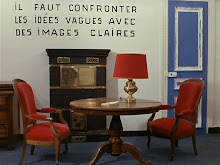
It was five years later, as part of a new partnership with filmmaker Anne-Marie Miéville, when Godard returned to the Palestinian footage to address these questions. The film that results is in some ways one of Godard's most austere works: all vestiges of narrative have been purged and there are no longer charismatic actors speaking for him. Instead we are given an intricate essay of images, sounds and text, combining the Palestinian footage with staged scenes of a working-class French family, photographs of politicians and war with advertisements, and the words of the Palestinians with those of Godard and Miéville. If the film seems excessively complex, it is first and foremost because its concerns are so basic. According to his biographer Richard Brody, Godard
blamed himself and Gorin for having attempted to make a film that was not about what the Palestinians were in fact saying and doing, but about what he and Gorin had wanted to say and to do (as was of course apparent from their storyboard and script).
To correct the mistake, it was necessary therefore to really see what was in the images that they had filmed, not what they had wanted to find or even what Al Fatah had wanted to show them. In order to do that, it was necessary to understand what it really means to film something in the first place. The French Marxist philosopher Louis Althusser, a major influence on Godard, wrote something in the '60s that sums up the project Godard had set himself:
I venture to suggest that our age threatens one day to appear in the history of human culture as marked by the most dramatic and difficult trial of all, the discovery and training in the meaning of the 'simplest' acts of existence: seeing, listening, speaking, reading---the acts which relate men to their works, and to those works thrown in their faces, the 'absences of work'.
In Ici et Ailleurs, this return to the "simplest" acts is not academic, but an act of repentance. Much of the Dziga Vertov Group's work could be said to have embodied gestures of solidarity, and even unity, with international radical struggles (films were also made in Italy, Britain and Czechoslovakia). The failure of the Palestinian project highlighted the illusions and elisions that made such an expression possible. Above all, it failed to take into account difference---between you and me, France and Palestine, filmer and filmed, and everything else. They weren't seeing clearly, and hence, they hadn't thought or acted clearly either.

The film has three main sections in which it attacks these problems. In the first, Godard's and Gorin's original vision for the Palestinian project is outlined. It was to consist of four key images: that of "the people's will", "the armed struggle", "the political work", "the prolonged struggle", with each image leading to the next and continuing until the final image: until victory. These are the images, as Daney put it, "that the PLO wants to see broadcast in France ... They are the images of any propaganda movie." As it turned out, victory was not the end point of this sequence of images, but death. Attaching this final image to the sequence, Godard is forced to re-evaluate the original images, as well as the process by which they were linked.
The second part of the film leaves Palestine to one side and explore the latter problem in more depth: the political implications of cinema's most fundamental powers, the juxtaposition of one image against another and of sounds against images. If the first part is defined by a unity (the revolutionary cause) and linearity (one thing leading to another leading to victory), the second part is all about differentiation, or put more positively, relationship. As Miéville reminds us in the narration, "in 1970 this film was called Until Victory---in 1975, it is called Here and Elsewhere." In this new formulation, the "and" becomes pivotal, and the second part of the film largely revolves around the search for the exact nature of this conjunction, the "et" that can both connect and separate. By this point, the unified, seamless progression of images has been discredited: text appears at one point claiming "death is represented in this film by a flow of images".
However, the implication is not that this seamless flow of images is really unified, but that by suppressing the question of relationship, it ends up instigating regressive ones. As critic Bill Nichols has written, "film cannot be reified into a thing. It is primarily a system of relationships between things". Godard suggests that the original project of Until Victory created a system of relationships that was ultimately disempowering and dishonest, and his claims that such "chains" of images threaten to replace us and alienate us from our own powers finds further evidence in the mass media all around us, and is illustrated in the film by the repeated intercutting of the French family passively watching TV. In fact, it closely echoes Guy Debord's theory of the Spectacle, that "vast inaccessible reality that can never be questioned" and which, Debord explains, is primarily "a social relation between people that is mediated by images". The question becomes not unity versus differentiation, but simply: what forms of relationship (what kinds of "and") are possible in cinema?
The third and final part of the film returns to the Palestinian footage, prepared to formally and critically investigate it: to understand what is really in the images, what relates them to and what separates them from each other. This section involves analyses both of what is in the Palestinian images, and what is left out of them. A scene depicting a militant leader speaking to a large group is criticised for its hierarchical structure: "The one that represents the people is speaking alone, far from the people. As usual, theatre." Another scene, of a young, illiterate woman learning a revolutionary statement by rote, is criticised for submitting an individual to someone else's words. Miéville asserts that "texts talk but never about silence"---in other words, they never talk about what they are excluding, and the great loss in this image is suggested to be what this woman would have said had she been allowed to speak with her own words.
This notion of silence is a recurring one, and sound is seen as one of the key methods of obscuring sight: earlier Godard laments that he had failed to see his images properly because the sound (exemplified by a blaring revolutionary anthem) was playing too loud. These were "sounds that hide silence", that obscured the image and drowned out what it had to say. But the biggest silence is the presence of the filmmaker himself. A close-up of a pregnant Palestinian woman talking about her willingness to give her son to the cause is revealed by Miéville to be a woman that Godard and Gorin have cast to play the part (and she is filmed, as James Quandt has observed, "with the same tender but wary regard" Godard used to treat Anna Karina in his earlier films). We are allowed to hear Godard behind the camera, directing her to "straighten your head a little" and Miéville observes, "It's always the one who is directed that is seen, never the one directing".
Another key aspect of this sequence is that, while the voice of Godard led the earlier parts, Godard and Miéville are now equal narrators, with Miéville taking on a somewhat adversarial role, challenging, as Brody puts it, "both his earlier approach to the subject and his attempt to make good on it now". She even goes so far as to say to Godard what all of us have wanted to at one time or another: "Listen, be a little simpler!" This is not the first time Godard has collaborated with a lover, but unlike his previous wives and muses (the actresses Anna Karina and Anne Wiazemsky), this is the first time the "and" that connects them has been of a fully reciprocal, balanced nature.

The question the film confronts is whether such a relationship (in essence, a "prefigurative" one) is possible between the filmmaker and the filmed---and also, on the other side of the cinematic process, whether it is possible between the filmmaker and his viewers. The critical interrogation of imagery posited in the film's final section suggests some potential redemption (not least in offering a critical model for viewers to apply to other films)---but in the case of the Palestinian situation, this is of course too little too late. The real failure came at the moment of filming, the failure to understand what they were really engaging in : as Miéville puts it to Godard, "It was up to you to say it and what is tragic is that you didn't." There is even a further suggestion that the fascination with faraway struggles is partly motivated by an avoidance of our own present circumstances (and it's important to realise that the "elsewhere" in the film's title is not just distant Palestine, but also our alienation from our own lives). Miéville, as usual, puts it most pointedly: "If we wanted to make the revolution for them, it's perhaps because at that time we didn't really want to make it where we are."
All of the filmmakers in this series have contemplated the potential limits of film as a political form. In response to a film critic's praise over his innovative use of cinematic techniques in The Fall, Peter Whitehead responded dejectedly:
But I had been trying to change the world not the language of cinema, confront the fascist tyranny of objectification of everything and everyone. I felt defeated, betrayed by film, my own film most of all. Vicarious avoidance of participation; a preoccupation which was its own predicament.
Whitehead would give up film soon after this film (he was spent most of the last forty years working as a falconer for a Saudi Arabian prince). Robert Kramer, in a trajectory somewhat similar to Godard, gave up direct political engagement by the mid-'70s but continued making films until his death in 1999. If the act of filmmaking inevitably involves some kind of distanciation and disconnection from one's environment, Godard would no doubt argue that it's a necessary one. Critic Nicole Brenez has cited the philospher Maurice Merleau-Ponty to sum up Godard's approach:
At the conclusion of a reflection that first cuts him off, but in order to make him better feel the links of truth that attach him to the world and to history, the philosopher finds, not the abyss or the self or of absolute knowledge, but the renewed image of the world, and himself planted, among the others, in that world.
In this equation, cinema is a form of disconnection that can, in the end, facilitate deeper connection; it has the potential to, in Gorin's words, "drive you back to your own reality". If Godard's aim with Ici et Ailleurs was, as Daney put it, to"restore images to the bodies on which they have been taken", it was also arguably an attempt to restore himself to the world with renewed capacities, including the ability to live out responses to questions like: "How to use one's time to occupy space?" Or another one: "How to construct one's own image?"
Of course, with Godard, it always comes back to questions. Observing a French mother shrug off a difficult question from her daughter, Godard comments:
Nobody knows how to answer, or answers are crooked. We don't do much better anyway. ... One ends up thinking that it's not the answers that don't fit, but the questions.
It's a start.


Hi, I woud like to share a recent film with you in response to your blog. Thanks, Noe Kidder
ReplyDeletehttp://www.youtube.com/watch?v=JHRIP1gZtho&feature=player_embedded